
The West Australian Chittys
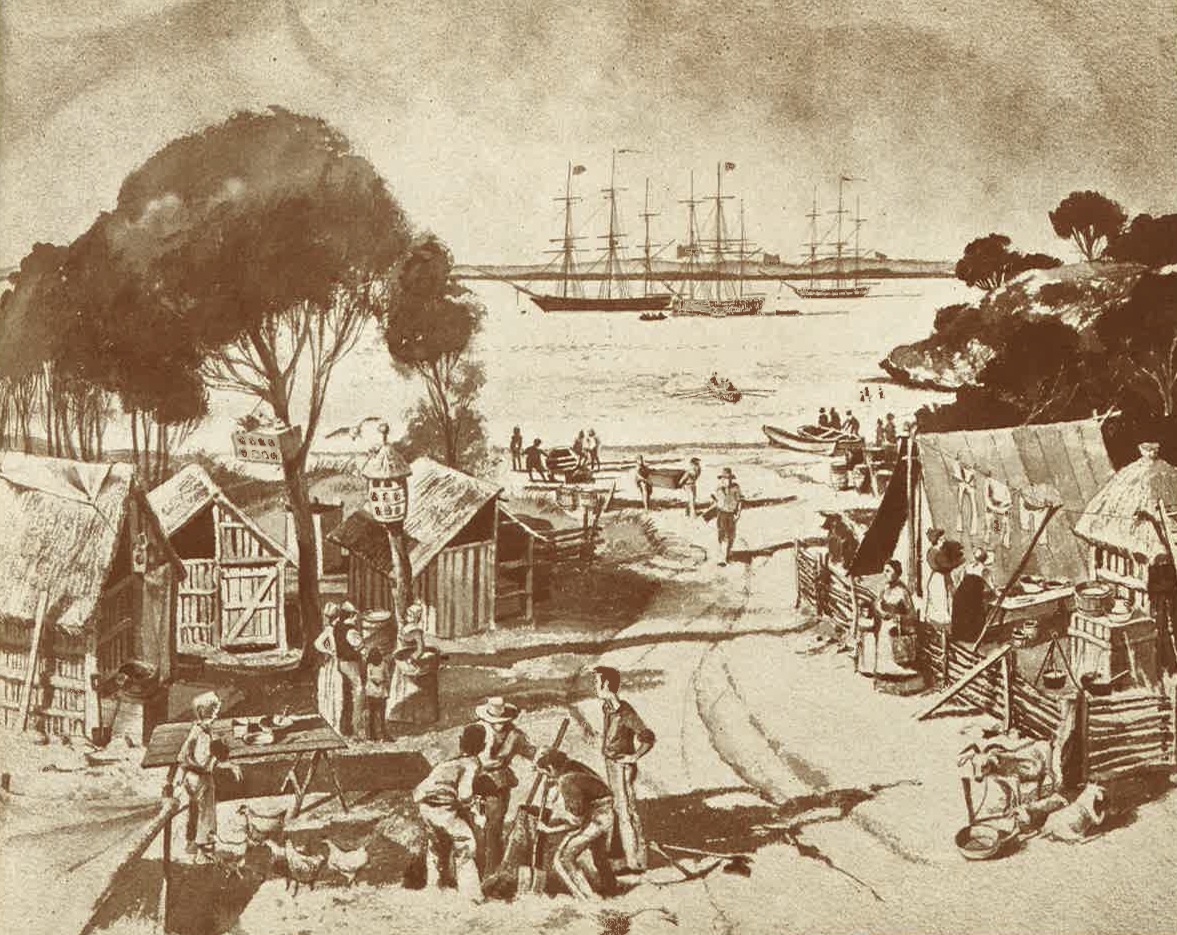
George Chitty, his wife Mary Allan French and family arrived in West Australia in 1843 settling in the Toodyay area. Toodyay, known as Newcastle between 1860 and 1910, is a town on the Avon River in the Wheatbelt region of Western Australia, 85 kilometres north-east of Perth. The first European settlement occurred in the area in 1836. After flooding in the 1850s, the townsite was moved to its current location in the 1860. The Chittys were farmers,
OLD TOODYAY.
Rocks and Reminiscences.
(By R.A.J.).
Overlooking the Avon at Jumperdine Pool a peculiar column-like formation of granite rears its polished sides somethirty feet above the scrub on a rock strewn hill.Recessed in several places, with a cave at the base, it stands out as a prominent feature among the rounded boulders and jagged rocks, scattered by the wrath of nature, in one of the wildest parts of the nearer Toodyay landscape. Like a sentinel guarding the riginal route from Toodyay to Perth, Nolan’s Rock commands a wide view of the surrounding country. This imposing piece of nature’s hand work has a colourful history and derives its name from Michael Nolan, a convict who absconded from the rigour and routine of prison life and work to win his freedom overseas. Apparently a good fellow, well liked and sheltered by the settlers in the district, he eluded all the efforts of the soldiery to capture him. The rock which bears his name was his retreat. From it, unseen, he could closely watch the movements of the soldiers, whence they came and whither they went as they persisted in their relentless search. Like a fox at night he would steal to some lonely cottage to receive, a kindly word, hospitality, food, and return to his den to await the opportunity to make good his escape. lt came at last. One, Frederick Lee, was driving to Perth and hidden in the dray Nolan reached the city, to be finally, in a barrel, smuggled aboard an outgoing ship at Fremahtle— to freedom. Such is the story told by Mrs. Martha Chitty, one of the oldest surviving Toodyay-born inhabitants, who, at the ripe old age of 83, is spending the evening of her life amid the quiet and the beauty of the Avon Valley below the hill crowned by Nolan’s Rock. I met her in her little cottage beside a road skirting the river that she knows so well. As she sat in her chair recalling childhood days and happy memories of long ago one could see that her long pathway, reverently trod, had not been paved with carefree days, but beneath those quiet blue eyes shone forth the spirit and the will to bear the trials and the sufferings known only to the early pioneers of her State.
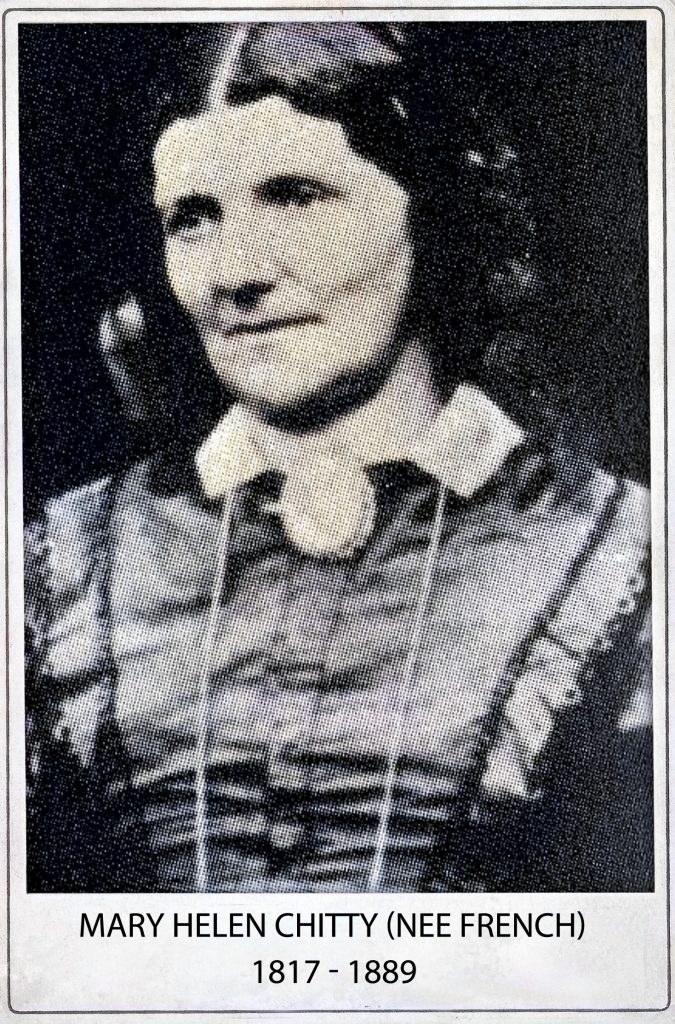
Proud she is of the fact that her mother, Charlotte Davis, was the first female to land on the shores of the Swan River. Among, the Parmelia’s passengers were Thomas Davis— a smith employed by Mr. James Drummond— his wife, Catherine, a son, John, aged 3 and Charlotte, aged 2. When on June 1, 1829, the contingent was transferred from Garden Island to the mainland, a soldier carried the little girl ashore, the first of her sex to touch the uninviting land. Mrs. Chitty‘s father, John Herbert, arrived in the colony a few years later and soon after his marriage in Perth, settled at Toodyay, where he built and conducted the Royal Oak Inn, which became the social centre of the tiny hamlet. There on April 29, 1850, Martha was born and in the district her long life has been spent. Her memory carries her back to those early days when life was a bitter struggle against adversity.: Ten acre fields, spade- cultivation, the bullock-drawn plough, the sickle, the scythe, the ‘flail or the roller on the threshing floor, the drays of sandalwood, bullock teams, the. noisy teamsters and their revels, the chain gangs,hard work, floods, monotony, are some of her pictures of the past. School and schoolmasters? When this subject was broached, with a ‘twinkle in her eye. she said, ‘A grey, black, wild bull.’ I .looked aghast, but soon. the explanation followed: ‘We always remember them like that: the schoolmasters of the early days”Grey, Blackston, Jonathan Wylde, ana Aquilla’ Bull.’ A suggestion that the reference was far from complimentary -was passed off with a’ smile, as she drew a fleeting picture of the annual fair held in October by the Agricultural Society— the huge marquee erected near the Royal Oak for luncheon, the stock tethered along the river bank, the invasion, white and black, from the surrounding districts, and the distinguished visitors from Perth, who came to enjoy the round of festivities and scatter their’ mirth and gaiety throughout the valley. The Governor, in his State carriage, with outriders, guards.and all, arrived to grace the function, and was accommodated at her father’s inn. Sometimes a troop of riders from the city —fifty strong or more — would come to enjoy the fun, moving onward to attend a dance at some distant homestead, and after the revelry ceased, to rest— the women in the house — the men in the barns or beneath the open sky. As a child she feared the convicts, but in the main considers most were decent fellows who did much to develop the district. Moondyne Joe— yes, she knew of him whose deeds are woven round with myth and mystery. Joe’s Cage and his name bestowed upon a rugged district where he ‘lived’ lower down the valley remind us of his reality. Visitors to Toodyay will be shown the very spot in the wall of the old gaol where he removed the stones and gained his liberty. Be that as it may. Some years later Joe was. captured and for a time lodged in the Newcastle gaol. He left behind him a tortoiseshell cat. It made its home in a nearby cottage. In 1871 Mrs. Chitty married. Her husband, Henry Thomas Chitty. farmed successfully at Jumperdine. Never robust, he died in 1896. Ten children there were — nine are living — and now there are forty-five grandchildren and twenty-four great grandchildren. Her life has gleamed with quiet content; her only cares, her home, her children, and so we’ll leave this grand old mother in the little cottage beside the river, looking out upon familiar scenes. She has lived to see the hundredth birthday of the district that has been her home so long.
Saturday 28 October 1933
The West Australian (Perth, WA : 1879-1954); Page 5 of 22
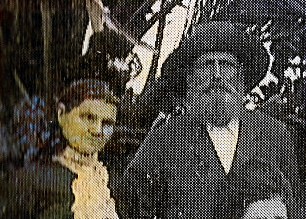
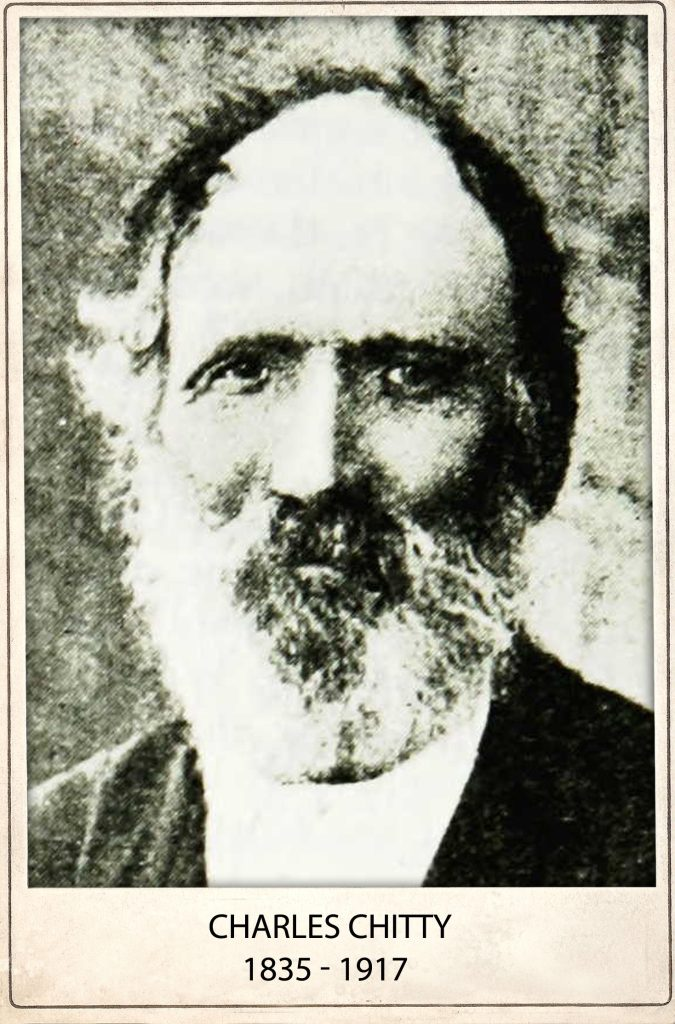
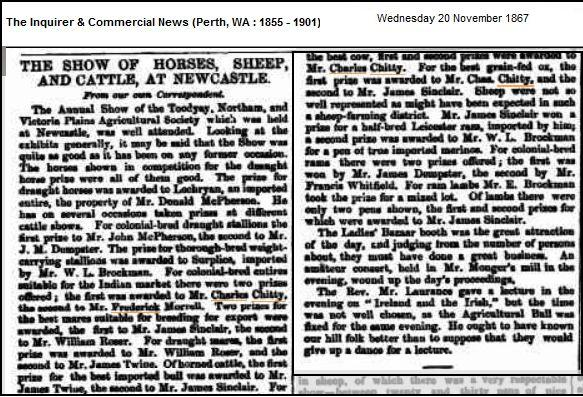
Charles Chitty
Charles and his wife Phoebe Sawyer
The Victorian Chittys
Charles Chitty (1809-1884) was a Godalming Chitty. He arrived in Melbourne 1849 aboard the James L Foord with his wife Phoebe Maria Sawyer after 2 children – Phoebe and Sarah died en route. The were part paying passengers at a cost of L22 10 shillings. A son, Henry Charles Chitty) was born on board the Foord.
They had a total of 9 children and remained in Victoria where a significant family developed.
Charles was the 6th cousin 3x removed of the Clendon bros.
Queensland Chittys
Richard Merrit Chitty (1839-1925) arrived Queensland in the early 1870s. He married Rose Aland (1851-1919). They moved to Lakemba in NSW. and had 7 children
7 children
7th cousin 1x removed fo Clendon bros.
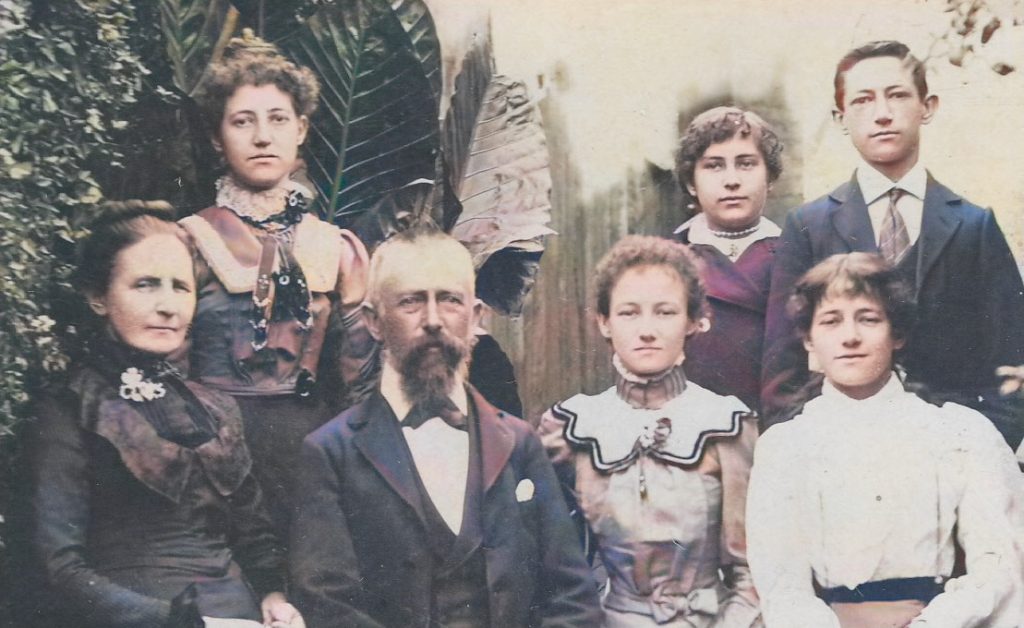
Photo above from left: Rose Aland, Eva Rose , Richard, Violet, Ruby at rear, Lillian at front and Frank at rear,https://sargisonfamilyhistory.com/chitty/tngfiles15/getperson.php?personID=I152498211456&tree=tree1
Another Chitty arrived in Melbourne at a similar time. Alfred Chitty (1849-1929 who was a son of Tompson Chitty, the English lawyer. He worked as a builder and married Elizabeth Wilson (1848-1922) on 4 March 1873. They were to have 10 children. Life was not easy as he seems to have been bankrupt in the early 1880s. He then became a newsagent.
Intriguingly he went on to become a world recognised expert on and collector of medals and tokens.
ALFRED CHITTY
A TRUE ANTIQUARIAN.
The death of Mr Alfred Chitty on Tuesday last removes from our midst a man of unique personality, who, although his name was very little before the public, was highly esteemed by those who knew him, both for his own sake and for the sake of his achievements. Throughout a long and busy life he had made the collection of coins the chief hobby of his leisure moments with the result that in his old age he was recognised as a world wide authority on Australian medals and tokens and in addition his general numismatic knowledge was sufficient to secure for him the task of classifying and arranging the coin collections in the public libraries of both South Australia and Victoria. It was indeed a fortunate chance which placed at the disposal of the authorities of those two institutions the services of an expert who notwithstanding his advanced age retained the keenness of his faculties; a man in whom the enthusiasm of youth had developed into an absorbing passion for his subject and a loving and meticulous care in dealing with his material.
But this was not all. When community of tastes drew me into the circle of Mr. Chitty’s acquaintanceship some 20 years ago I knew him first as a collector of early Victorian engravings and lithographs, and as I come to see more of him I found that he was a born collector of the antique.
Moreover he had discovered for himself by paths in which, if he was not the actual pioneer he had very few competitors. Who except the intimated few know any thing about “fire marks”? We may, when our attention is directed to it, find that we have a subconscious recollection of the custom that used to prevail among insurance companies of affixing a tin plate of distinctive design to the walls of buildings on which they had taken a fire risk. But who would dream of hunting out such of these old labels as remain and making a collection of them? Mr. Chitty not only did this but he also built up in interesting lore about Australian fire insurance companies, their origin, and their “fire marks,” and in papers read before the Historical Society of Victoria he presented the results of his researches with a prefatory account of the beginnings of fire prevention in Great Britain, and the origin of fire insurance societies in the 17th century. This is only one example of the thoroughness with which he investigated every subject which claimed his attention. Again he was not content to collect a few examples of old English china. He must needs give even this branch of collecting a local application, and get together samples of “Australian church tokens and church china.” I have myself delved a good deal into odd odd corners of Victorian history in the last couple of decades but I must confess that until Mr. Chitty brought them under notice I had no idea of the existence of specially manufactured chinaware for the use of certain Australian churches at tea meetings and similar social gatherings,or of “tokens” used at communion services with a similar special application.A few years ago Mr. Chitty made a holiday trip to Tasmania and came back with a new department added to his private museum. He had been collecting samples of handmade bricks manufactured by convicts, and bearing, in some cases, deliberately impressed thumb-prints of some of those unfortunates, this mark being placed I understand on every hundredth brick! Not were his Tasmanian interests limited to brickbats. I remember that on the last occasion on which I saw him he insisted on playfully donning a short jacket plentifully adorned with broad arrows, which he has rescued as one of the relics of that grim period of our history.
It is easy, perhaps, to deride the “antiquarian spirit”: but the antiquarian is,after all, a man with a wider vision of the future than most of his fellows. The day will come when these relics of “the old colonial days” will have a hundredfold greater value in Australia than they have to-day. Mr. Chitty, before his death, presented a valuable collection of coins to the Public Library. Let us hope that the remainder of the results of his lifelong collecting will also pass into public hands,and so be preserved to the nation.
I have written these few hurried lines in the hopeof giving some adequate idea of the little-known activities of a man who was himself a simple minded, lovable personality. Although a son of a famous lawyer of last century – what lawyer has notheard of Thompson Chitty the author of “Chitty on Torts”? – Alfred Chitty elected in his youth to follow outdoor occupations, and for some years after his arrival in Melbourne in 1871 he was a builder. Later hebecame a news agent, but, having acquired sufficient means to live in modest comfort, he had long lived in a retirement which was broken only by those calls to public service to which I have referred.
His work at the Public Library here was carried on until a couple of years ago, when advancing age compelled him regretfully to relinquish it and to those who found their way into the coin room adjourning the National Museum he was ever ready to give the benefit of his wide and deep numismatic knowledge. As far as I know, his only published works, apart from his contributions to the Numismatic Society of Great Britain and other scientific societies were a catalogue of Australian tokens and a pamphlet on Australian Fire Marks
I like to remember him best is the collector at home by his own fireside, surrounded by the results of so many years patient searching – a hobbyist par excellence, always ready to descant on one of his favourite topics to a visiting friend.
There are few men who will leave behind them kindlier recollections than Alfred