
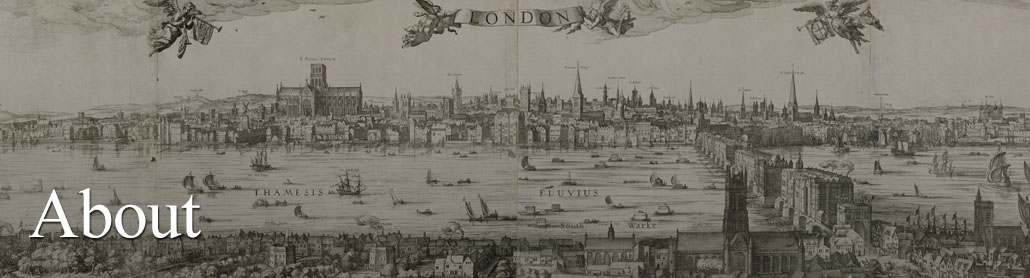
Given its closeness to Godalming it is hardly surprising the the Chittys could not resist Londons’s magnetic appeal. Erik Chitty has an excellent and as usual detailed account of this below.
http://chittyoflondon.awardspace.co.uk/page2.htmll
It seems clear enough that it was a family of clothiers that started the move.
Mathew Chitty of Godalming & North Warborough lived in Godalming until 1587 when he sold his tenement and garden then moving to North Warborough where he died in 1610. His son and his wife Elizabeth had at least 5 children of whom Abraham completed the move to London.
Abraham Chitty (1582-1665) was a clothier operating in Oldiham and London. He married Alice Parks (1582-1665) in St Laurence, Poutney, London in 1608. There were 8 children.
While living in Oldiham he apprenticed his son Abraham to Richard Lawton, a cooper in London in 1637.
Abraham and his family were living in St Dunstan in the east of London by 1654.
Three generations later Sir Thomas Chitty(1696-1762) was Lord Mayor of London and the first Chitty knight.
Joseph Chitty (1729-1795) of Smyrna and Dagenham, a merchant, married Sarah Cartwright (1750- 1820) in1771 in Essex. They had twelve children two of whom effectively began two distinctive London Chitty dynasties:
- Joseph Chitty(1775-1841) a barrister began the prominent family of London lawyers (see separate page)
- Charles Chitty of Muntham (1781-1866) began the armed forces/Indian service family through his two sons: Arthur Whatley Chitty (1824-1905) a captain in the Indian Navy and Walter Theodore Chitty, a Major General in the Bengal Army.
Mathew Chitty of London & Amsterdam 1646-1761)
Matthew CHITTY (died about 1716), of St Peter Cornhill, Bishopsgate Street Within, and Amsterdam, merchant, son of Henry, married twice, but records of his baptism, marriages and burial are as yet all untraced. The dates of signing and proof of his Will show that he died between 1712 Mch 23 and 1716/7 Jan 21, probably at Amsterdam, where the Will was made. The Probate describes him as ‘of parts overseas’. Both his wives were Amsterdam ladies, but he and the first had their home in London until at least 1685.
The first wife was Catherine de MOUSON and the approximate date of their marriage is indicated by a certificate of membership issued to her at Amsterdam for the London Dutch Church at Austin Friars, 1675 May 5. About 1680, Rachel ROMBOUTS, a widow in their service, made attestation at this church; and in 1681, Apr 13, ‘Le Sieur Mattieu CHITTY and Madle Catherine de MOUSON his wife’, Madle Catherine de la FONTAINE, widow of the late M. Jean de la FONTAINE, Madle Marie de MOUSON, her daughter, and Rachel, her servant, brought further certificates from Amsterdam to the London Church.
In 1685, Matthew, as executor of his father Henry, was plaintiff in a Chancery action concerning trade accounts – arrears of an earlier action by Henry.
Matthew is said to have traded at Amsterdam in the name of ‘CHITTY and ZOONAN’.
Did Matthew who died about 1716 use the arms first officially registered in 1759? Rietstap’s ‘Armorial Général’ gives for ‘CHISSY [sic] of Amsterdam’: ‘or, a chevron ermine, in chief three lion’s(?) heads gules erased.’ If these queried lions were in fact talbots, this is the CHITTY coat with tinctures reversed. It is not easy to guess how Rietstap could have read ‘or’ and ‘gules’ in reverse; but that Matthew used this variant seems unlikely when we find ‘CHITTY of London’ impaled in his married daughter’s family, the ST QUINTINs, in Harpham Church. This last mentioned use at least implies, if it does not prove, that the arms were used by the common ancestor, Abraham I (1582-1665).
Matthew and Catherine had four children, two very short-lived:
1. Henry baptised at St Peter Cornhill 1675/6 Jan 28 and buried there Mch 2 following. The Burial record calls him ‘son of Henry’ – an obvious clerical error.
2. Catherine baptised 1677 Oct 23/24 at both St Peter and the Dutch Church at Austin Friars. She pre-deceased her father, having married Hugh ST QUINTIN (1671-1712/23); their elder son William succeeded as 4th Baronet ST QUINTIN of Harpham, Yorks, and had issue. The name CHITTY was given as a last baptismal name to several of their descendants, and, though the male line and the baronetcy have long been extinct, descendants who had assumed the name of ST QUINTIN continued until at least 1913.
3. Agneta baptised 1681 Aug 25 at Austin Friars, married Theodore HUYGENS who was living in 1712; she died between 1759 Jun 22 and 1760 Feb 6 as ‘Lady Agneta CHITTY widow of Theodorus HUYGHENS, Magistrate and Council of Amsterdam’, leaving effects, stocks and credits in Great Britain. One of the executors was Worshipful Wilelm HUYGHENS Lord of Honroop, High Sheriff of Amsterdam. The Will was proved in the P.C.C.
4. Elizabeth baptised 1684 Jun 22 at Austin Friars and buried 1685 Sep 1 in the North Aisle of St Peter Cornhill.
Matthew married secondly Elizabeth Ten CROOTENHUYS of Amsterdam, formerly De DIEN, a widow with two children, Lodowick Ten CROOTENHUYS who died 1724 Jun 1, unmarried, during his mother’s lifetime, and Jacoba Elisabeth, wife of Theodor BOONDEMAHER. Theodor was living in 1712 and Jacoba in 1724, and they had a son Jacob.
In his Will (proved in the P.C.C), Matthew names his daughter Agneta, his grandsons William and Matthew ST QUINTIN, and also his sons-in-law Hugh ST QUINTIN and Theodore HUYGENS who were to be executors and to allow Matthew’s widow to live rent free for one year in his dwelling-house – his country house and residuary estate being for the use of his executors. Joost de SMETH was named executor with them.
Taken from URL: http://chittyoflondon.awardspace.co.uk/page29.html
Adam Jellicoe, husband of Elizabeth Chitty
Adam Jellicoe b.1725
b. 11 Aug. 1725 (CM-C), place of birth not known. According to a printed pedigree of John Rushworth 1st Earl Jellicoe (p.c. 15 April 2003), his parents were Adam [b.pre-1703] and Sarah née Wilson. m. Elizabeth Chitty 13 Feb. 1755 St. Olave Old Jewry, London (IGI; CM-C agrees with name). Ten children: Sarah b.1755, a boy who died in infancy, Samuel b1758, Joseph (1) b.1760, Elizabeth b.1762, Adam James b.1764, Anna b.1766, Mary b.1767, Joseph (2) b.1769 and Harriet b.1771 (CM-C).
Deputy-paymaster of seamen’s wages (GM 1789 Vol. 59 Part 2 p.864). Evidently lived in Portsmouth as all their children were baptised there.
On 29 April 1767 he appeared at the Old Bailey as a witness in the trial of Mary Peck for deception and perjury. She was indicted for ‘unlawfully, wilfully, and knowingly taking a false oath before a surrogate in the Commons, with intent to receive wages, prize money and allowance money due to Richard Walker, deceased, late a seaman on board his Majesty’s ship the Modeste’. Adam Jellicoe said: ‘I am a clerk to the treasurers of the Navy, employed to pay seamen’s wages at Portsmouth. On Tuesday the 17th of February, I was in the Pay-office; the prisoner came in and applied to Mr. Hill, desiring to know if the other seamen of the Modeste were paid or not. Mr. Hill asked her . . . . . ‘ [the testimony continues at length, and there were several other witnesses]. Mary Peck was found guilty and sentenced to death (POB).
On 14 May 1777 he again appeared at the Old Bailey, this time in the trial of James Newbery for deception and fraud. Newbery was indicted for ‘that he, knowing that David Jones had lately served our Lord the King on board the frigate or ship of war called the Acteon, and supposing wages due to him in respect of his service, did personate and assume the name and character of the said David Jones with intent to demand and receive the wages then due to the said David Jones’. Adam Jellicoe was the first witness; he said: ‘I am clerk to the treasurer for the payment of his majesty’s navy; upon the 15th of April the prisoner applied at my house in Broad-street and demanded the wages of David Jones of the Acteon.’ However Adam had been warned in a letter from Francis Gray, gunner of the Acteon, that Newbery was planning to impersonate Jones, so Newbery was ‘taken before my lord mayor’. In his defence Newbery claimed to have had a written agreement with Jones that ‘the longest liver should have all’. The agreement was burnt with the ship, and Jones was said to have died later. Newbery was found Not Guilty (POB).
On 23 and 28 August 1781 Adam appeared before a committee of the House of Commons, giving details of his salary, which was eighty pounds a year plus allowances and perquisites; the total in the year 1779/80 was £305 5s. 10d. He had been in the office for over 40 years (Journals of the House of Commons 22 Geo. III, pp.717/8). On 21 Oct. 1782 he appeared again, this time giving a detailed statement of the arrangements for paying naval officers and men. His statement (Journals of the House of Commons 23 Geo. III, pp.71/2) begins:
This Examinant saith, That he is First Clerk in the Pay Branch in the Office of the Treasurer of the Navy. He is now employed in paying the Officers and Seamen at the Pay Office in London; he formerly paid them at the Yards and Out Ports. The Wages of an able Seaman are One Pound Four Shillings per Month, . . .
In the course of these duties Adam had come to know Henry Cort (b.1740), a navy agent (one who acts on behalf of naval officers and men to seek prize money and back pay from the authorities). In 1775 Cort joined a business in Gosport, Hants., providing iron goods to the Navy, and he developed new forging techniques which greatly improved the quality of their products. To take advantage of the innovation considerable investment was needed, and in 1781 Adam agreed to lend Cort £20,000; in return he was to get half the profits, 5% interest, and his son Samuel was to join Cort as a partner. But the £20,000 was at least in part money entrusted to him to pay seamen, which he had no business to risk in this way. Further loans soon followed, and in a note dated 11 November 1782 he wrote that the loans had ‘employed so much more of my money than I expected, that I have been obliged to turn most of my Navy bills into cash, and at the same time, to my great concern, am very deficient in my balance. This gives me great uneasiness, nor shall I live or die in peace until the whole is restored.’ He gradually got deeper into debt, and his misuse of public money was eventually discovered in August 1789. It seems that he was already ill, and his death may well have been hastened by the disgrace of the discovery. (Sources: (1) Industrial biography: iron workers and tool makers by Samuel Smiles, 1863, Chapter VII, available online at courses.ed.asu.edu/gonzalez/APHB/ETexts/Smiles.S/Indust%20Biography.txt and elsewhere; and (2) www.discoverycentres.co.uk/gosport/localstudies/henry-cort.html).
d. 30 Aug. 1789 in Highbury-place, Islington (GM 1789 Vol. 59 Part 2 p.864, CM-C agrees with date).
On 24 Sept. 1789 the following notice appeared in The Times:
An extent is issued by Government against the effects of the late Adam Jellicoe, Esq., Deputy Paymaster of the Navy, to the amount of 34,000 l. sterling, which this Gentleman is deficient in his accounts.
An ‘extent’ was an order for seizure and sale of property to meet debts owed to the Government. As a consequence of this order, the following notice appeared under the heading of Sales by Auction in The Times on 26 March 1790:
HIGHBURY PLACE. By Mr. WHITE, By Virtue of his Majesty’s Writ of VENDITIONI REPONAS on the Premises, on Wednesday, the 7th of April next, at Twelve o’Clock, THE VALUABLE LEASEHOLD, GENTEEL, WELL-BUILT DWELLING-HOUSE, with OFFICES, COACH-HOUSE, STABLING and GARDEN walled round, being No. 14 on that most distinguished Spot HIGHBURY-PLACE, ISLINGTON, a Situation truly delightful, and the Vicinage most respectable, late the Property and Residence of ADAM JELLICOE, Esq. deceased.
The Premises are in the most compleat state, fit for immediate reception; held for a Term of 50 years from Michaelmas next, at a Ground-rent of only Nine Guineas per Annum.
On that, and following Days, will be sold the elegant HOUSEHOLD FURNITURE, PLATE, WARDROBE of LINEN, LIBRARY of BOOKS, FINGER ORGAN, with Four Stops, WINES, LIQUORS, and other VALUABLE EFFECTS.
To be viewed Six Days (and the Effects Two Days) previous to the Sale, when printed Particulars may be had at Garraway’s and Peele’s Coffee Houses, and of Mr. White, Storey’s-Gate, Westminster.
After Adam’s death Cort, who had pledged his patents to Adam, was declared bankrupt, and bizarrely Samuel was then left to take over the business in Gosport and nearby Fontley, and to profit from Cort’s outstandingly successful techniques (see Samuel Smiles’ book as above).
An entry under Adam’s name appears in the wills index for 1864, 75 years after his death:
JELLICOE ADAM Effects under £100 15 March [1864] Letters of Administration of the personal estate and effects of Adam Jellicoe late of Islington in the county of Middlesex Gentleman a widower [sic] deceased who died 1st September 1789 [sic] at Islington aforesaid were granted at the Principal Registry to Richard Jellicoe of St. Lawrence Pounteney lane in the City of London Esq. the Acting Executor of the will of Samuel Jellicoe the son of the said deceased, the said Richard Jellicoe being first sworn.
This Richard is Adam’s grandson Richard b.1795.
Mark CD Ashdown originally shared this on 12 Jul 2009
John W Chitty(1730-1805)
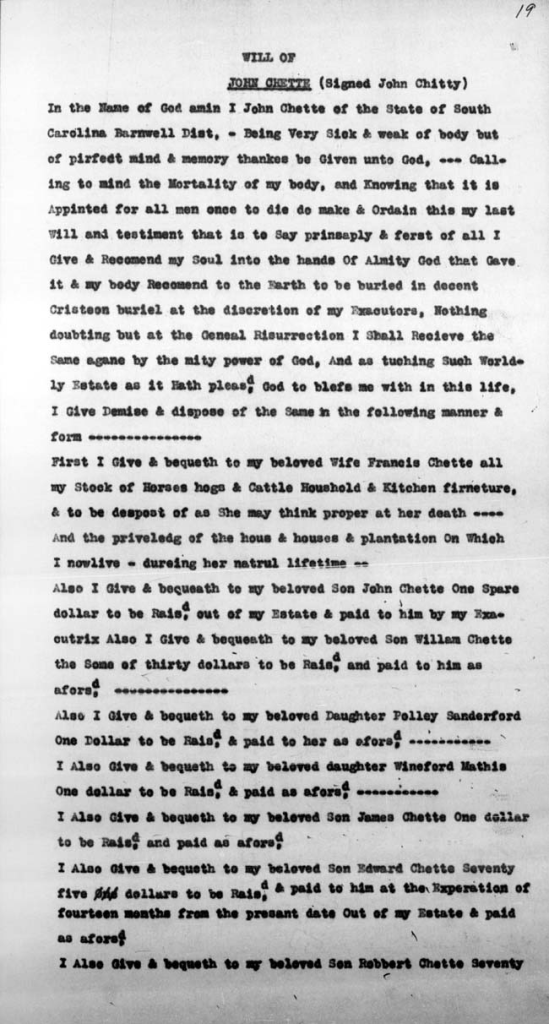
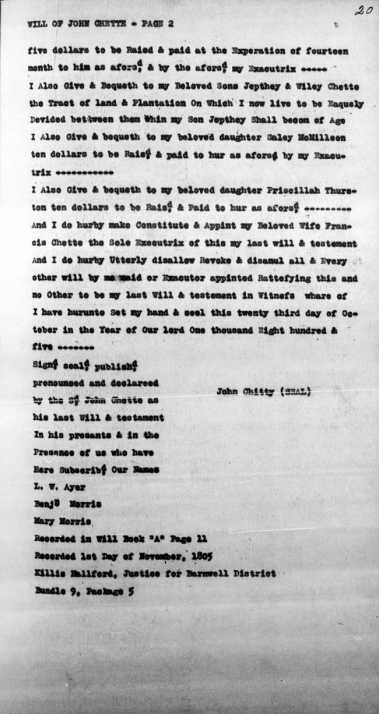
James Chitty
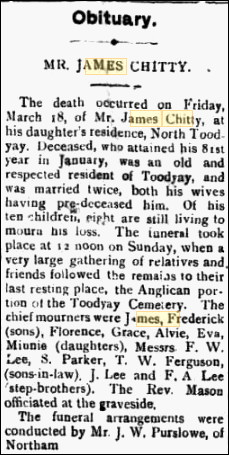
26 Mar 1927, Toodyay Herald